Tutorials
How Much Does a 3D VTuber Model Cost?
Compare free, VRoid, and custom 3D VTuber model costs. Plan your total budget for rigging, expressions, usage rights, tracking, and streaming.
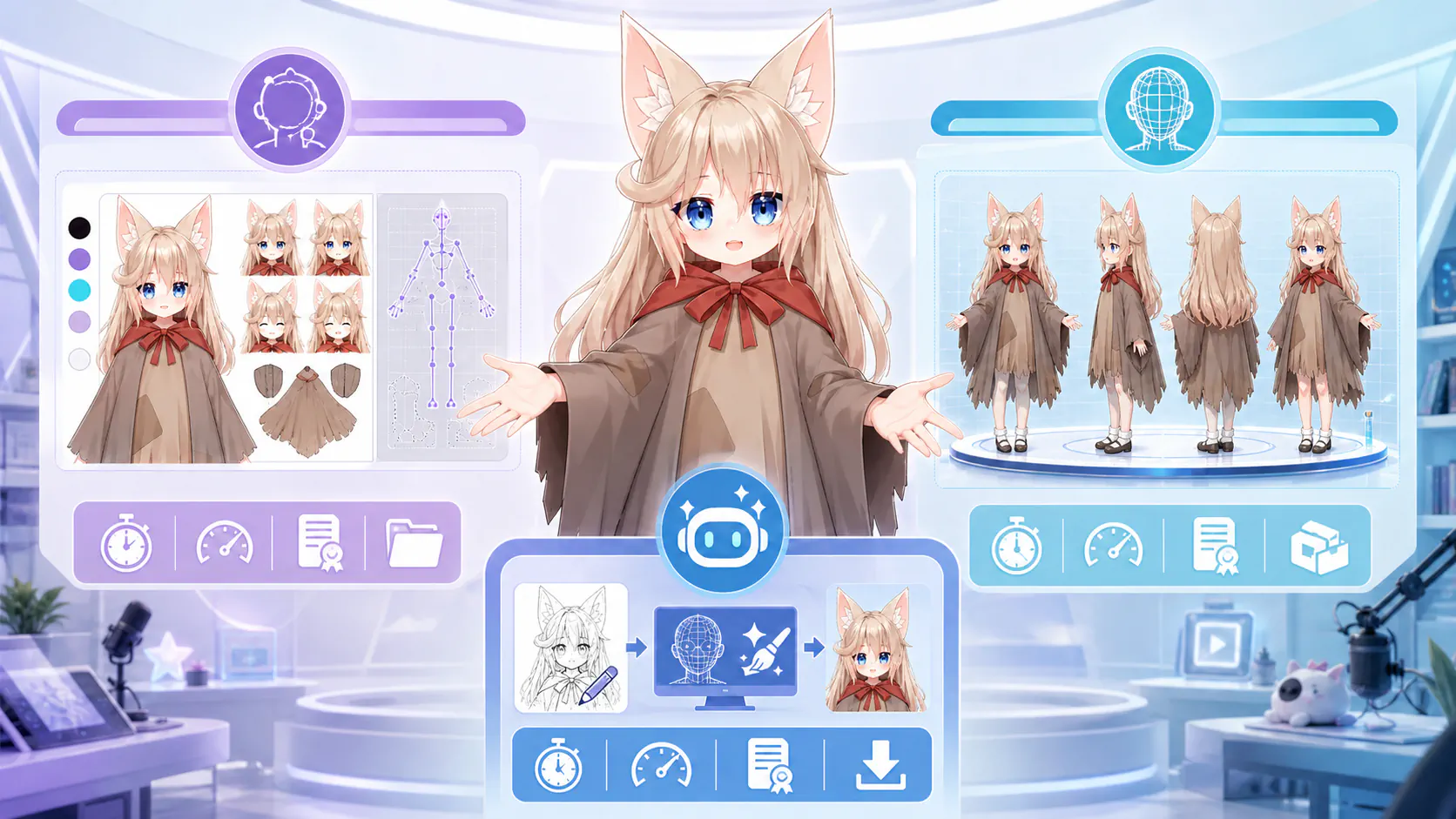
A 3D VTuber model can cost $0 if you make it yourself in VRoid Studio, a few hundred dollars for a VRoid commission, or several thousand dollars for a model built from scratch. For a custom 3D commission, a working budget of $1,500–$5,000+ is a useful starting point. Complex designs and specialist work can cost considerably more. The model invoice is only one part of your launch budget: expressions, usage permissions, software, and any equipment you need must fit too.
These are planning bands, not a measured market average or guaranteed quotes. Public artist listings checked on October 3, 2026 illustrate the differences: Rainu Raiju lists a VRoid base model from $100 and a version with custom clothing from $150; Minikotoba lists VRoid commissions from $500. MK Atelier lists a standard 3D model at $1,500, while Astrexis lists models built from scratch from $3,000. Availability and final prices need confirmation with each artist.
3D VTuber Model Prices by Creation Route
| Route | Model budget | What to check before spending |
|---|---|---|
| DIY VRoid Studio | $0 for the software; optional assets extra | Time to customize, asset permissions, and VRM export settings |
| Premade 3D model | Set a shopping limit, such as $200; use the actual listing price | Whether the model is shared with other buyers, editable, and licensed for your use |
| VRoid-based commission | Roughly $100–$1,000+ as a planning band | Custom textures, hair, clothing, accessories, and expression setup included in the quote |
| Custom 3D model built from scratch | Roughly $1,500–$5,000+ as a planning band | Modeling, textures, body rig, facial expressions, physics, and tested delivery format |
| Specialist or studio commission | Individual quote; can exceed these bands | Additional outfits, unusual anatomy, advanced facial work, support, and delivery schedule |
| AI-assisted 3D workflow | The service's public plan or credit-pack price, plus any editing you commission | Generation allowance, expression setup, download availability, and compatibility with your streaming app |
VRoid Studio is free and exports VRM files. You can use its presets and sliders to build a first avatar without paying a model artist. Bought clothing, textures, or other third-party assets have their own terms, so include both their price and permitted uses in your decision.
A VRoid commission pays an artist to customize that workflow. A model built from scratch can accommodate shapes, clothing, and proportions that need separate modeling. Ask which method the artist uses; the word “custom” alone does not tell you what you are buying.
There is no fixed ceiling. For example, Mari's commission page lists a general range of €5,000–€8,000+, with higher prices possible depending on the project. Those figures are in euros, not US dollars. Compare quotes in the same currency and account for any tax or payment conversion charges.
What Should a 3D Model Quote Include?
A polished render does not show whether a model is ready to track your face. Request an itemized quote and a demonstration in the application you intend to use.
| Item | What you are paying for | What to confirm |
|---|---|---|
| Character design and reference sheet | The design an artist will translate into 3D | Is this included, or must you supply finished references? |
| Modeling and textures | Body, hair, clothing, materials, and surface detail | Which outfit and accessories are included? |
| Body rigging and skin weights | A skeleton and how the mesh bends with it | Do shoulders, elbows, and neck move cleanly? |
| Facial expressions | Blinks, mouth shapes, smiles, and expression controls | Which expressions work, and is advanced phone tracking extra? |
| Hair and clothing physics | Movement of hair, fabric, and accessories | Does the target app support the settings being delivered? |
| Export and setup | A usable file and any app-specific configuration | Which VRM version or application package will you receive? |
| Editable source files | Projects such as .blend or .vroid | Are they included, and may another artist edit them later? |
A .vrm is a runtime avatar file; receiving it does not mean you also receive the original Blender project. Learn what a VRM file contains before comparing deliverables.
Facial tracking can be a separate line item. MK Atelier's published extras include ARKit blendshapes at $120 and additional outfits from $100. These are examples from one artist, not standard fees across the industry. Ask for a quote covering the expressions and clothing you actually need. MK Atelier's price list
Calculate the Total Cost to Start Streaming
Use two separate totals so a monthly subscription does not get confused with a one-time model purchase:
Launch budget = model + missing production work + required usage permissions + new equipment + initial software or assets + taxes and payment fees + contingency.
First-year budget = launch spending + recurring charges for the months you use them + planned upgrades.
Only add items that are missing from the quote. If the model package already includes rigging, expressions, and monetized streaming permission, do not budget for them a second time. A deposit is part of the agreed commission total, rather than an additional model fee.
Check these costs before committing:
- Reference artwork: If you have no finished design, budget for a VTuber reference sheet or an artist's design service.
- Extra production work: Additional expressions, outfits, source files, optimization, or conversion for another app may need a separate quote.
- Usage permissions: Confirm monetized streams, sponsored content, merchandise, and editing permissions individually. There is no universal licensing surcharge.
- Equipment: Reuse your existing computer, webcam, and microphone if they handle a test recording. Phone tracking, hand tracking, and full-body equipment are separate upgrades.
- Software and assets: Include paid tracking apps, subscriptions, overlays, and other assets you choose to buy. You do not need to purchase every item at debut.
- Contingency: Consider keeping 10–20% of your planned one-time spending available for changes. This is a suggested reserve, not an artist fee.
Free software can keep the launch budget down. VSeeFace provides free webcam-based VRM tracking on Windows, and OBS Studio is free streaming and recording software. Check format compatibility: VSeeFace's documentation specifies VRM 0 support, rather than VRM 1.0. An incompatible export can mean extra conversion work.
Three Worked Budget Examples
The following figures are illustrative spending plans, not service offers. They assume you already own a suitable computer and camera, the required streaming permissions are included, and no additional taxes or payment fees apply. Replace those assumptions with your actual quotes.
| One-time item | DIY trial | VRoid commission | Custom 3D commission |
|---|---|---|---|
| Model | $0 | $500 | $1,500 |
| Reference/design work | $0 | Included | $150 |
| Additional facial setup | $0 | Included | $120 |
| Equipment and optional stream assets | $50 | $150 | $200 |
| Subtotal | $50 | $650 | $1,970 |
| Suggested 10% reserve | $5 | $65 | $197 |
| Launch budget to set aside | $55 | $715 | $2,167 |
If you also choose a hypothetical $15/month service for a full year, add $180. The custom example would then require a first-year allocation of $2,347, including the reserve. Unspent contingency stays in your budget; actual spending may be lower. A new computer, tracking phone, or full-body setup would increase these totals.
Why Quotes and Timelines Vary
Design complexity affects several stages at once. More layers of clothing can mean additional modeling, textures, skin weighting, and clipping checks. Extra expressions need to work both on their own and when combined with blinks or mouth movement. A static preview cannot demonstrate those interactions.
Queue time also differs from production time. MK Atelier lists 15–20 business days of production, depending on complexity; another artist may have a substantial wait before work starts. Confirm the queue date, review milestones, and delivery date before scheduling a debut. MK Atelier's commission details
Rush work, confidentiality until debut, additional revisions, and new designs introduced after approval may carry extra fees. Ask for these terms before paying. Agreeing on the design during the reference and modeling stages usually makes later changes easier to manage.
Commercial Rights and Future Updates
Ask the creator to state which uses the quoted price covers: monetized streams, videos, sponsorships, merchandise, and changes by another modeler. Permission to stream does not establish permission for every other use.
Some artists include limited commercial streaming rights and charge separately for broader use. Astrexis, for example, describes limited streaming and social-media permissions in its terms, with broader commercial rights discussed separately. This is why a single percentage surcharge is a poor budgeting rule. Astrexis's commission terms
Plan for updates too. A second outfit, hairstyle change, or expanded expression set may be a new commission. Confirm whether source files are provided, whether another artist may modify them, and how long post-delivery fixes are available. Save the agreed quote and terms with your model files.
Where Virmii Fits in a 3D Avatar Budget
Virmii offers an AI-assisted route to generating a 3D avatar, testing browser face tracking, and displaying it through an OBS stage. Compare the public pricing page with your expected generation and expression usage when deciding what to spend. Include any separate artist work you want for cleanup or customization.
For generated models, Virmii's expression artwork plays inside its previews, Live Studio, and OBS stage. That artwork is not embedded in the downloaded VRM. If your plan is to use the download in another application, test its existing expressions and budget for any additional facial work you need. Uploaded VRMs use the expression bindings already present in their files. The Virmii avatar and OBS tutorial explains the workflow and its limits.
Choose this route when you want to test a character and streaming setup before deciding how much to invest in further customization. Compare the resulting avatar against your design and expression requirements before treating it as your finished debut model.
What About a 2D Live2D Model Commission?
A 2D model needs a different production quote: separated character artwork and Live2D rigging. These can be sold together or by separate creators. Compare the combined price, included expressions, usage permissions, and source-file terms with a complete 3D quote. An art-only price is not comparable to a rigged 3D package.
Neither format is always cheaper. A simple VRoid avatar and a bespoke Live2D model have very different scopes; so do an elaborate 3D character and a premade 2D model. Choose the visual style and motion you need, then compare complete packages. Our guide to making a VTuber model covers the main creation routes.
Before You Pay a Deposit
- Write down the application, tracking method, outfit, and expressions you need.
- Confirm the production method, delivery format, editable files, and permitted uses.
- Request a total quote listing included work and separately priced extras.
- Watch a tracking demonstration with head turns, blinks, speech, and combined expressions.
- Agree on revision limits, queue and delivery dates, payment milestones, and cancellation terms.
- Add missing hardware, recurring charges, and a reserve to your budget.
For a first channel, a DIY avatar or a modest VRoid commission leaves more room to test your content. If your design needs modeling from scratch, request quotes with the same scope from several artists and compare them against your total launch budget. Use the VTuber setup checklist to check what else you need before debut.
Frequently Asked Questions
How much does a fully rigged 3D VTuber model cost?
A VRoid-based commission can cost a few hundred dollars; a model built from scratch can require several thousand. A $1,500–$5,000+ planning budget is a starting point for custom 3D work, with specialist projects potentially higher. Confirm that “fully rigged” includes the facial expressions, physics, and delivery format you need.
Can I make a 3D VTuber model for free?
Yes. VRoid Studio is free, and a compatible avatar can be tracked and recorded with free software. You still need suitable equipment, time to customize and test it, and permission to use any third-party assets you add.
Does rigging include advanced facial tracking?
Not necessarily. A body rig, basic blinks and mouth shapes, and an extended ARKit expression set are different deliverables. Ask which are included and request a tracking demonstration.
Do I need full-body tracking to use a 3D model?
No. A seated stream can use webcam face tracking with a 3D avatar. Full-body tracking adds equipment and setup requirements if your content needs captured body movement.
Is a model commission a one-time payment?
The agreed model purchase can be a one-time expense paid in installments. Future outfits, revisions, paid tracking apps, and subscriptions may add separate costs. Calculate your launch and ongoing budgets independently.